What Are Effective Strategies for Universities to Address Student Employability Skill Deficits?
The most effective strategy is simple: close skill deficits while there is still time to act, during the degree itself. Here are four strategies to get there.
Summary
The most effective strategy is simple: close skill deficits while there is still time to act, during the degree itself. Here are four strategies to get there.
- Embed soft and technical skills directly into coursework. Update it to match current industry tools. Offer micro-credentials so students graduate with proof of ability, not just knowledge.
- Make internships mandatory. Run capstone projects with real companies. Use virtual simulations for students without access to in-person placements.
- Start career guidance from year one. Use VMock for AI-powered resume feedback and PeopleGrove for alumni mentorship. Use Leapath to give career services teams a live dashboard of every student’s readiness score.
- Build structured industry partnerships. Host regular job fairs. Use 12twenty to manage employer relationships and recruitment in one place, and Leapath to connect employers directly to pre-assessed student shortlists based on verified skill data.
Introduction
Universities that address employability skill deficits early produce graduates who are ready for the job market, not just qualified for it.
The strategies that work span four areas. Embedding soft and technical skills directly into the curriculum rather than treating them as optional extras. Building experiential learning through internships, capstone projects, and virtual simulations that give students proof of ability, not just knowledge. Strengthening career services with early guidance, alumni networks, mock interviews, and resume tools that prepare students before rejection does. Forming industry partnerships that shape programmes from the inside, so the skills being taught match the skills employers are actually hiring for.
The gap between education and employment is not inevitable. It is a visibility problem, and it is fixable.
1. Curriculum and Skill Integration
The fastest way to close the skill gap is to stop treating skills as an add-on and start building them into the curriculum itself.
Only 30% of 2025 graduates find jobs in their dream fields. The gap is not about effort. It is about what is being taught and how. Universities focus on soft skills. Employers want practical, job-specific ones. Until both are built into the curriculum itself, graduates will keep leaving underprepared.
Here is what universities can do to fix that:
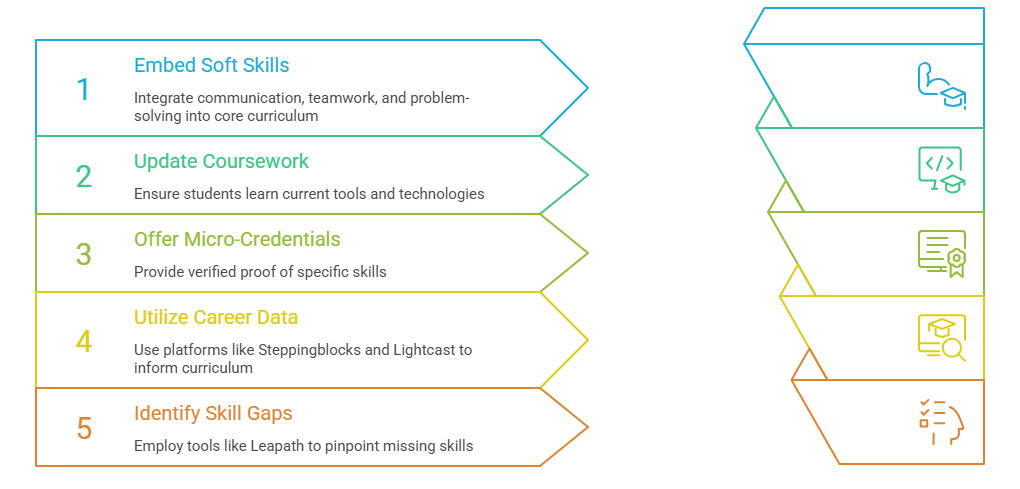
- Embed the skills employers actually look for into core coursework, not an optional module.
- Update this coursework regularly. Students should not be learning tools employers stopped using years ago.
- Offer micro-credentials in specific tools like project management software or data platforms. Students graduate with verified proof of a skill, not just a grade.
Knowing what to update is just as important as updating it. Two tools help universities make that call with real data rather than assumption:
- Use Steppingblocks, an online career data platform, to see where graduates actually end up and which skills got them there. That data tells universities what to teach, not what looked relevant five years ago.
- Use Lightcast to track which skills employers are actively hiring for. Update programmes before they fall behind, not after graduates stop getting hired.
Even with the right data, implementing it through multiple online tools and softwares takes time.
Leapath, an AI SaaS platform, brings it all together in one place, showing universities exactly which skills their students are missing against real job requirements. Universities get one clear dashboard instead of scattered reports and spreadsheets, making it easier to act on decisions quickly.
If you want to see what this would look like for your own students, Leapath offers a free consultation.
2. Experiential Learning Programs
Real skills are built through real experience, not just by embedding them in the coursework.
The classroom builds the foundation. The workplace puts it into practice. Universities that build structured, practical experience into their programmes produce graduates who are ready, not just qualified.
Here is how universities can build real experience into the degree:
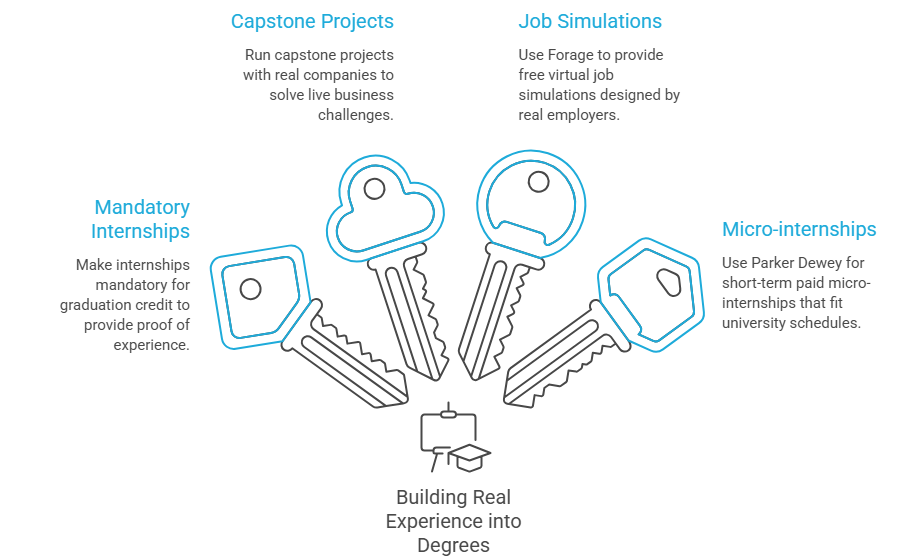
- Make internships mandatory for graduation credit. Students who complete structured internships enter the job market with proof of experience, not just a transcript.
- Run capstone projects with real companies. Give final-year students a live business challenge to solve. The student gets a portfolio piece. The company gets a fresh perspective.
When internships and companies aren’t within reach, the following platforms step in.
- Use Forage, an online platform for students who cannot access in-person placements. It offers free virtual job simulations designed by real employers. Students get real project experience without geographic barriers.
- Use Parker Dewey, an online platform for short-term paid professional experience. Students complete micro-internships that fit around a university schedule. They gain real work exposure before graduation.
Together, these approaches mean no student has to graduate without ever testing their skills in the real world.
3. Proactive Career Guidance
Most career services teams are reactive. The most effective ones are not.
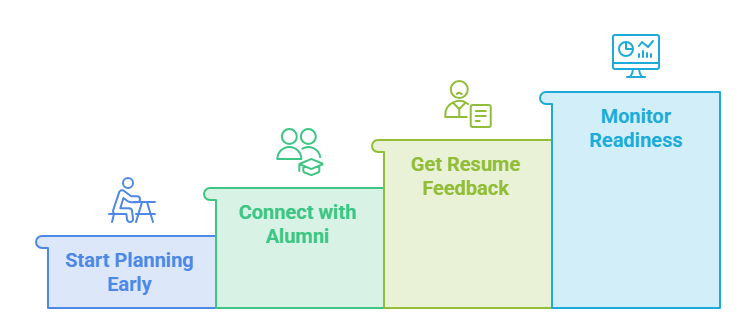
The students who get hired fastest are rarely the ones who waited until final year to start. The networks a student builds during university shape their outcomes more than most universities acknowledge, and personal referrals are the most decisive factor in securing employment for 25% of graduates. Starting that process from year one, not the final semester, makes the difference.
Building that head start at scale is where the right platforms come in:
- Use PeopleGrove to connect students with working graduates. It matches students with alumni for career conversations, informational interviews, and ongoing guidance. The kind of network that leads to referrals.
- Use VMock, an online platform to give students instant, scored feedback on their resume before they submit a single application. Students see exactly what is holding them back without waiting for a human advisor.
- Use Leapath, an AI SaaS platform, to give career services teams a live dashboard showing exactly where every student stands, so advisors see who needs help before a rejection does. That same insight works for other stakeholders as well. Students get a public profile that turns their skills, certifications, and live projects into something recruiters and alumni can actually see, not just a line on a resume.
Career services teams are not short on expertise. They are short on time, and these tools give that back.
4. Industry Partnerships
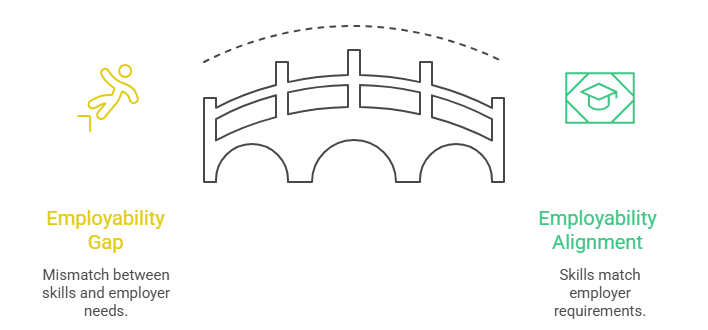
The universities closing the gap fastest are not doing it alone.
University-industry collaboration is one of the most effective ways to close the employability gap. When industry shapes programmes from the inside, the alignment is built in. When it does not, universities are always playing catch-up.
Here is how universities can build industry partnerships that actually work:
- Invite industry leaders to review and shape degree programmes regularly.
- Host regular job fairs and campus recruitment drives throughout the degree. Employers get early access to talent. Students stay connected to the job market before graduation.
- Build labs equipped with current tools. Students get hands-on experience with the exact platforms they will use in the workplace.
Running this many partnerships at once is where things usually fall apart, and that is where the right platforms come in:
- Use 12twenty, an online tool to manage employer relationships and recruitment in one place. It centralises job postings, student appointments, employer engagement, and outcome reporting.
- Use Leapath, an AI SaaS platform, to connect employers directly to pre-assessed student shortlists. Hiring decisions are based on verified skill data, not unverified applications.
Partnerships work when they run on structure, not goodwill. These tools are what make that structure possible.
Conclusion
The strategies that will make the biggest difference are the ones that start earliest.
Curriculum updates and industry partnerships take time to design and implement. But proactive career guidance and experiential learning can begin immediately, with the right tools already available. VMock gives students instant resume feedback from day one. PeopleGrove builds the alumni networks that lead to referrals. Forage and Parker Dewey give students real work experience without waiting for a formal internship programme to be built. Leapath ties it all together, giving career services teams a live view of every student’s readiness so they can act on the right information at the right time, not after a rejection has already done the damage.
The universities that close the employability gap fastest will not be the ones with the most resources. They will be the ones that start earliest, use data to guide every decision, and treat career readiness as something that is built throughout the degree, not handed to students at the end of it.